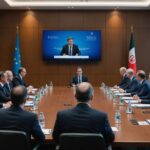



- President Trump is preparing for a high-stakes direct meeting with Chinese President Xi Jinping as the Iran conflict continues to escalate across the Middle East.
- Washington enters the talks without a clearly defined set of objectives, raising serious concerns among allies and market participants about the summit’s outcome.
- The parallel pressure of an active Iran war and unresolved US-China trade tensions — with tariffs still above 100% on key Chinese goods — makes this one of the most complex diplomatic moments of Trump’s second term.
A Summit Defined by Chaos, Not Clarity
President Donald Trump walks into his upcoming meeting with Chinese President Xi Jinping carrying more geopolitical baggage than any US leader in recent memory. With American military assets actively engaged in operations tied to the Iran conflict, and no coherent public framework for what Washington wants from Beijing, the summit carries enormous risk — and equally enormous opportunity. Analysts tracking both theatres warn that unclear goals entering such a meeting can produce dangerously loose commitments.
Iran Conflict Adds Urgent Pressure on Both Sides
The timing of this meeting is no accident. Iran’s escalating position in the Middle East has sharpened the urgency of US-China dialogue, given Beijing’s longstanding energy and trade ties with Tehran. China purchases an estimated 90% of Iran’s oil exports, giving Xi substantial leverage over Iran’s financial resilience. Trump’s team will almost certainly push Beijing to use that leverage — either through reduced purchases or diplomatic pressure — as part of any broader deal framework. Whether Xi moves on that front, or uses it as a bargaining chip for trade concessions, will define the summit’s legacy.
“China purchases an estimated 90% of Iran’s oil exports — giving Xi Jinping significant leverage that Washington desperately wants to influence.”
Trade War Backdrop Clouds Diplomatic Atmosphere
The meeting does not occur in a vacuum. US tariffs on Chinese imports remain punishingly high — above 100% on select categories following rounds of escalation through 2024 and into 2025. Both economies have absorbed damage. American consumers face elevated goods prices, while Chinese exporters have scrambled to reroute supply chains through third-party nations. Any signal from this summit — positive or negative — will move markets immediately. Forex desks in Dubai and Singapore are already positioning for volatility around the meeting date.
What the Middle East Is Watching
For Gulf states, this summit carries direct implications. A US-China détente could ease pressure on oil pricing dynamics, particularly if Beijing signals continued demand commitments while Washington softens some trade restrictions. Conversely, a breakdown — or worse, a vague communiqué with no binding deliverables — risks prolonging the strategic uncertainty that has hammered investment confidence across emerging markets. The UAE and Saudi Arabia, both deepening economic ties with China, have a direct stake in the summit’s tone.
Uncertain Goals: The Biggest Risk Factor
Perhaps the starkest concern heading into this meeting is the absence of a clearly articulated US agenda. Diplomatic summits without defined objectives tend to produce photo opportunities rather than policy shifts. Trump’s negotiating style favours improvisation, which has occasionally yielded breakthroughs — but against a methodical, long-horizon strategist like Xi, improvisation carries real downside risk. Investors and policymakers across the Gulf and Asia are watching whether Washington can convert this high-pressure moment into a durable framework, or whether it becomes another missed inflection point.

The Trump-Xi summit is a binary event for risk assets in the Gulf and broader EM space — a productive outcome could unlock a relief rally in trade-sensitive sectors and ease oil market jitters, while a vague or hostile result risks compounding the uncertainty already generated by the Iran conflict. For Dubai-based investors, the critical variable to watch is whether Beijing offers any concrete movement on Iran oil purchases, which would signal a genuine quid pro quo and give Trump a tangible win to bring home. Without that, expect the summit to produce noise rather than signal.